
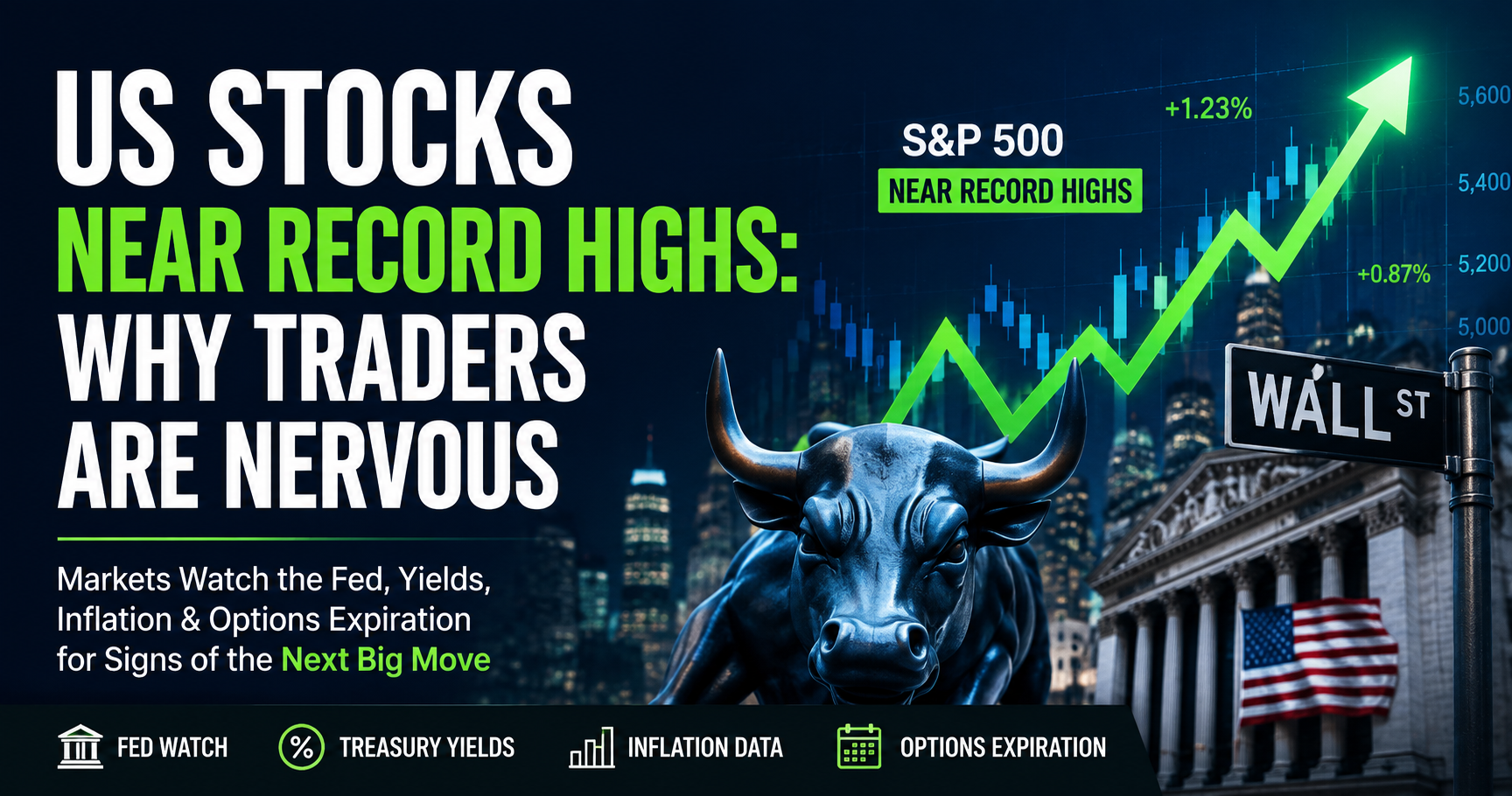
US Stocks Near Record Highs: Why Traders Are Nervous
US stocks are near record highs as traders watch the Fed, Treasury yields, inflation, and options expiration for signs of a market move.
Wall Street's September Volatility: What's Behind It and What Comes Next
Wall Street entered September with the S&P 500 near record territory and daily price swings unusually small for weeks on end. That calm rarely lasts and this month it broke, as a Federal Reserve rate decision, a wave of options expiration's and a string of economic data releases converged in the same short window.
A Jackson Hole Speech Reset the Fed Odds
The catalyst was the Fed. At the Jackson Hole Economic Policy Symposium in late August, Fed Chair Kevin Wash delivered a forceful speech insisting inflation remained "too high" and had been for too long pushing the market-implied odds of a September rate hike from around one in three to better than 50/50 within a single session. That repricing rippled through bond markets: the 10-year Treasury yield climbed from roughly 4.2% earlier in the year toward the high-4% range, a shift that changes how investors value stocks relative to safer alternatives like bonds.
On September 16, the Fed followed through, raising its benchmark rate a quarter point to a target range of 3.75%–4.00% its first hike since 2023 while signaling more increases could follow this year. Equities responded with the choppy, two-way trading typical of a "priced-in" decision: rather than a clean rally or selloff, major indexes swung in both directions across the session and the days after, as investors weighed how many further hikes might be coming.
A Volatile Jobs Report and Quarterly Options Expiration Add More Moving Parts
The rate decision landed alongside an unusually volatile jobs report, adding another variable for the Fed to weigh. September also brought "quadruple witching" the quarterly expiration of a large batch of stock options and futures contracts which tends to add trading volume and occasional sharp intranet moves, independent of any actual news.
A Historically Weak Month Follows an Unusually Calm Summer
None of this arrived in isolation. September has historically been the weakest month for US indices, and it followed a summer in which realized volatility how much stocks actually moved day to day sat near multi-year lows. Calm stretches like that don't last forever, and traders tend to grow more cautious the longer one drags on.
What "Ready for a Big Move" Actually Meant
When analysts describe stocks as "ready for a big move," they're rarely predicting a direction. They're describing a setup: low volatility, several scheduled events that could shift the outlook quickly, and valuations that leave little room for surprises to be shrugged off.
On valuation, the Schiller cyclically adjusted price-to-earnings ratio a widely followed long-term measure climbed to levels seen only once before in over 140 years of market history, during the run-up to the dot-com peak. That doesn't mean a crash is coming; elevated valuations can persist for years. But it does mean stocks are priced for an optimistic future, leaving less cushion if growth, inflation, or corporate earnings disappoint.
At the same time, a narrow set of themes chiefly companies tied to AI infrastructure, including chipmakers, memory manufacturers, and server builders has driven an outsizes share of this year's gains. When a market's gains concentrate in a few names, a shift in sentiment toward that theme can move the broader index more than it would in a year with gains spread more evenly.
Bond Yields Are Competing With Stocks for Investor Money
Rising Treasury yields matter beyond the bond market. As yields climb, bonds become a more attractive alternative to stocks for income-focused investors, and higher yields raise the "discount rate" used to value future corporate earnings a mechanical reason rising rates can pressure stock prices even when a company's underlying business hasn't changed.
AI Deal making Keeps Fueling Enthusiasm and Concentration Risk
Major AI acquisitions have kept the sector's momentum alive. NVIDIA's early-September agreement to acquire Hugging Face, the widely used open-source AI model-hosting platform, for roughly $12.9 billion is a prime example. Deals like this have been a genuine tailwind for the broader market but they also mean the index's fortunes are increasingly tied to whether AI spending and enthusiasm continue at their current pace.
Chip makers have been a big part of that story, and you can read more about the AMD stock rally and what could come next.
September's Seasonal Reputation Adds a Psychological Layer
September has historically produced average declines across the S&P 500, Dow, and Nasdaq, a pattern some attribute to fund managers re balancing portfolios or locking in gains after a strong summer. Seasonality alone rarely drives markets, but when it lines up with real catalysts like a live Fed decision, it tends to draw more attention than usual.
Options Expiration Mechanics Can Amplify Short-Term Swings
The mid-September expiration of a large volume of stock and index options can force trading that has little to do with company fundamentals, as market makers adjust their hedges. That tends to make the days around expiration choppier than normal, independent of any news.
What It Means for Everyday Investors
For anyone with money in a 401(k), brokerage account, or index fund, this setup is less about predicting the next move and more about understanding why headlines about market swings may get louder in the weeks ahead. Periods like this often bring a jump in financial news coverage, social media commentary, and short-term trading chatter some of it useful, plenty of it noise.
This isn't a signal to make sudden portfolio changes based on a single news cycle. Decisions about buying, selling, or re balancing depend on individual circumstances time horizon, risk tolerance, existing holdings that a general market outlook can't account for. Anyone considering a significant change to their investments amid this kind of volatility may find it worth talking it through with a licensed financial advisor rather than reacting to headlines alone.
What to Watch Next
Inflation and employment data will keep shaping expectations for the Fed's remaining 2026 meetings, especially after policymakers signaled openness to further hikes. Other central banks have decisions of their own this month too, and moves in any of them can ripple into US markets given how interconnected global bond markets have become. Corporate earnings guidance, especially from companies tied to AI infrastructure spending, will offer another read on whether that theme still has room to run. And geopolitical developments, including tensions involving Iran that have already pushed oil prices and bond yields around this year, remain a wildcard markets are still pricing imperfectly.
The Bottom Line
What made this stretch different from an ordinary quiet spell was the sheer number of scheduled events converging in the same few weeks something that doesn't happen every September. Markets can usually absorb a Fed decision, a batch of options expiring, or a seasonal soft patch on their own without much drama. It was the overlap that gave traders pause this time and why "big move" became the phrase people kept reaching for.
Written by
ArhamYou might also like
Russell 2000 Trading Trends: What Small Caps Did in 2026
Learn what the Russell 2000 is, how small-cap stocks moved in 2026, and why interest rates matter. A simple beginner’s guide to Russell 2000 trading trends.

Cryptocurrency Trading in the US Market Trends, Risks and Key Insights
This beginner-friendly guide explains how US crypto trading works in 2026. It covers market trends, US regulations, crypto taxes, popular exchanges, and the main risks, with practical tips for trading more safely.
Why Gold Trading Is Getting More Attention From US Traders
Gold trading is getting more attention from US traders as interest rates, the dollar, inflation data, and gold futures shape the market. Here is how these factors work, and what risks come with trading gold.
Why AMD Stock Is Moving Higher and What Comes Next
AMD stock crossed a $1 trillion market value in September after record Data Center growth and a new $8.2 billion acquisition. Here is what is behind the rally, the numbers that matter, and the risks to keep in mind.
Comments (0)
Be the first to comment.