How Financial Services Are Changing in the US in 2026
Banking apps, AI, instant payments, and embedded finance are changing how Americans manage money. Explore the financial services trends 2026 and learn simple ways to stay safe and save smarter.
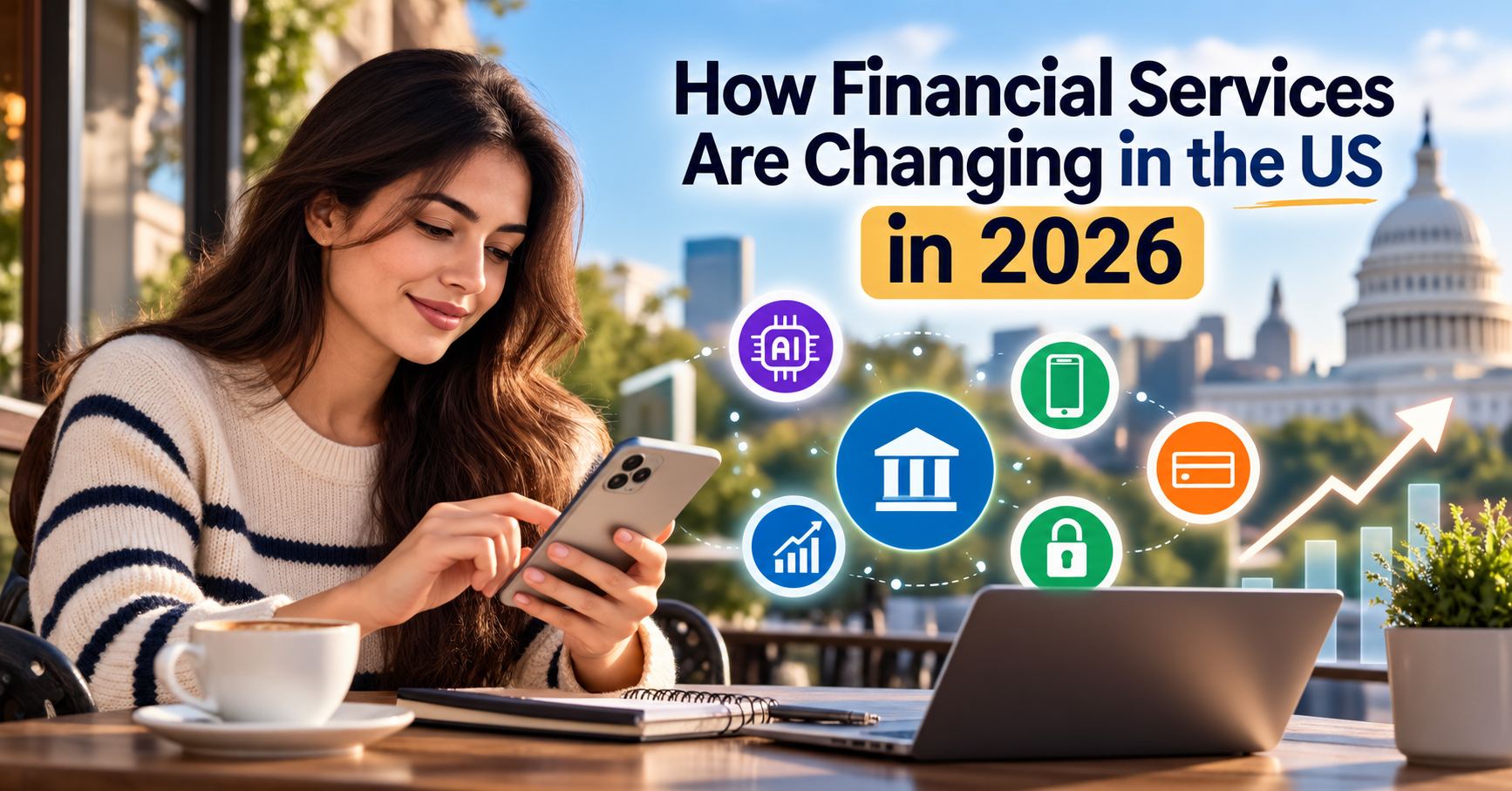
Opening a bank account used to mean visiting a branch, filling out paperwork, and waiting for a card in the mail. Today, many people do it from their phones in minutes. The change doesn't stop at account opening. Payments, lending, budgeting, and fraud protection are all being rebuilt around software. That makes it harder to know which changes help you and which ones deserve caution.
This guide walks through the biggest financial services trends 2026 is bringing to American households and small businesses. You'll learn how AI is reshaping banking, why instant payments matter, what embedded finance means, and what you can do to stay safe and save money.
1. AI in Banking Is Moving From Buzzword to Daily Tool
Artificial intelligence has been used in finance for years, mostly behind the scenes. In 2026, more of it is visible to customers.
Customer service and personal guidance
Many banks now use AI-powered assistants to answer routine questions, explain fees, or help dispute a charge. When they work well, you skip the phone queue. When they work poorly, you get stuck in a loop and want a human. The better banks make it easy to reach a person when the assistant can't help.
Some apps also use AI to flag unusual spending, predict when your balance might run low, or suggest moving money into savings. Think of it as a budgeting coach that never sleeps, though it only sees what your accounts show it.
Fraud detection and credit decisions
Behind the scenes, banks use machine learning to spot suspicious patterns, such as a card suddenly used in two distant places. Lenders also use more data points to assess risk, which can help people with thin credit files.
There is a trade-off. Regulators, including the Consumer Financial Protection Bureau (CFPB), have stated that lenders must still give specific reasons when they deny credit, even if a complex model made the decision. Fairness and transparency remain active debates. Supporters argue AI can widen access to credit. Critics worry about biased data and decisions nobody can explain. Both concerns are reasonable.
2. Digital Banking Trends: The Branch Moves to Your Phone
Among the most visible digital banking trends is the steady shift from branches to apps. Federal Reserve consumer surveys have shown growing use of mobile banking over the past several years, and the direction has not reversed.
What "digital-first" looks like now
Mobile deposits, card controls, instant balance alerts, and in-app support are standard. Newer features include:
- Freezing and unfreezing a card with one tap
- Virtual card numbers for online shopping
- Spending breakdowns by category
- Early access to paychecks at some institutions
Branches are not disappearing, but they are changing
Banks have been closing some branches and redesigning others as smaller advice centers. For people who prefer in-person help, such as older adults or small business owners handling cash, this matters. If your local branch closes, ask about alternatives like video appointments, shared banking centers, or community banks and credit unions nearby.
The FDIC's national survey of unbanked and underbanked households has repeatedly shown that a minority of Americans still lack full access to mainstream banking. Digital tools can help close that gap, but only when they work for people with limited internet access or low digital confidence.
3. Instant Payments Are Becoming the New Normal
Waiting days for money to move is starting to feel outdated.
The Federal Reserve launched its FedNow Service in July 2023, joining The Clearing House's RTP network, which has operated since 2017. Both let participating banks send money in seconds, any time of day, including weekends. Peer-to-peer apps have made quick transfers familiar to consumers for years, and now the underlying bank infrastructure is catching up.
Where you'll notice it:
- Paychecks and gig income: Some employers and platforms can pay workers immediately.
- Bill payments and refunds: Money can arrive the same day instead of in several business days.
- Small business cash flow: A shop owner who gets paid right away can cover supplies without waiting on a transfer.
The catch: Instant also means hard to undo. If you send money to the wrong person or to a scammer, getting it back can be difficult. Speed makes double-checking more important, not less.
4. Embedded Finance: Banking Inside the Apps You Already Use
Embedded finance means financial services built into non-financial products. You may already use it without noticing.
Everyday examples
Imagine a freelance designer who uses an invoicing app. The app sends invoices, accepts card payments, offers a business account, and even offers a short-term advance on unpaid invoices. She never visits a bank's website. Or think of a retailer's checkout page offering to split a purchase into installments, or a ride-hailing app providing a debit card for drivers.
Behind the scenes, a licensed bank usually holds the money or makes the loan, while a software company provides the user experience. This arrangement is often called "banking as a service."
Benefits: convenience, fewer steps, and tailored products for specific groups like gig workers or online sellers.
Risks: It can be unclear who is responsible when something goes wrong. Is it the app, the partner bank, or both? Check that deposits are held at an FDIC-insured bank and understand who to contact for disputes. Embedded finance also makes borrowing frictionless, which is helpful when you need it and tempting when you don't.
5. Fintech Trends 2026: Competition, Partnership, and Consolidation
The fintech trends 2026 landscape looks less like a battle between startups and banks and more like a complicated partnership.
Banks and fintechs are working together
Many fintech companies lack their own banking charters, so they partner with banks. Large banks, in turn, buy or license technology instead of building everything themselves. For customers, this means familiar brands may run on very different technology than before.
A shakeout after the boom years
Higher interest rates and tighter funding in recent years pushed many fintech firms to focus on profitability rather than rapid growth. Some smaller players have merged, pivoted, or shut down. When choosing a financial app, consider how established the company is and where your money is actually held. A slick interface says little about long-term stability.
Buy now, pay later and new lending models
Buy now, pay later (BNPL) options are widely available at online and in-store checkouts. The CFPB has studied the market, raising questions about how consistently these loans are reported and how easily people can overextend themselves with several small plans at once. Used carefully, BNPL can help spread out a planned purchase. Used casually, it can quietly stack up.
6. Fraud and Security: The Cost of Convenience
Faster, more digital finance gives criminals more places to operate. The Federal Trade Commission, which publishes consumer fraud data, has reported fraud losses in the billions of dollars each year in recent years. Impersonation scams and investment scams are among the more common types.
Scams to watch for
- Impersonation: Someone pretends to be your bank, a government agency, or a family member in trouble.
- Authorized push payment scams: You are tricked into sending the money yourself.
- Fake investment opportunities: Often promoted on social media or messaging apps, with promises that sound too good to be true.
How institutions are responding
Banks are adding stronger identity checks, device recognition, passkeys, and real-time alerts. Some now add a short delay or warning on unusual transfers. Regulators and industry groups continue to debate who should bear the loss when customers are tricked into sending money. Consumer advocates push for stronger protections, while banks point to the difficulty of stopping payments that customers approve. This remains unsettled, so assume you carry more responsibility than you'd like.
7. Regulation and Digital Assets: The Rules Are Still Taking Shape
Financial rules in the US are shifting, and the details can change quickly.
Open banking and data sharing
Apps often need access to your bank data to work, for example to link accounts or verify income. The CFPB issued a rule in 2024 on personal financial data rights, often called the "open banking" rule, intended to give consumers more control over sharing that data. Its implementation has faced legal challenges and agency review, so the final shape is still evolving. Check the CFPB's website for the current status.
Stablecoins and digital assets
In July 2025, Congress passed and the President signed the GENIUS Act, creating a federal framework for payment stablecoins, which are digital tokens designed to hold a steady value. Supporters say clearer rules could make digital payments safer and more competitive. Skeptics point to risks around reserves, oversight, and consumer protection. Either way, regulators are implementing the law over time, and the practical effects for everyday consumers are still emerging.
A balanced view
Reasonable people disagree on how much regulation is ideal. Some argue that lighter rules encourage innovation and lower costs. Others argue that stronger rules are needed to protect consumers from new kinds of risk. The best approach for you is to stay informed and choose products from providers that explain clearly how they operate.
What This Means for You
Here are practical steps to benefit from these changes while limiting risk.
For everyday consumers
- Turn on alerts. Enable transaction notifications and unusual-activity warnings in your banking app.
- Use strong authentication. Choose passkeys or an authenticator app over text-message codes when offered.
- Confirm FDIC or NCUA coverage. FDIC insurance generally covers up to $250,000 per depositor, per insured bank, per ownership category. Fintech apps are not automatically insured, so check how your funds are held.
- Slow down on instant payments. Verify the recipient before you send, especially for large amounts.
- Read the fees. Early pay, instant transfer, and subscription fees can add up.
For small business owners
- Compare embedded finance offers with traditional options. Convenience sometimes costs more.
- Keep records of every account and integration so that switching providers later is manageable.
- Ask what happens to your data and funds if a fintech partner closes.
For students and first-time earners
- Build a simple budget first, then choose tools that support it.
- Treat BNPL like a credit card: only use it for purchases you'd already planned to afford.
Key Takeaways
- AI is improving customer service and fraud detection, but human support should remain easy to reach.
- Mobile-first banking is standard, while branches are being redesigned rather than fully replaced.
- Instant payments are expanding, which brings speed and a higher need for caution.
- Embedded finance puts financial products inside everyday apps, so always check who actually holds your money.
- Fraud is a growing concern, and awareness is your first line of defense.
- Regulation on data sharing and digital assets is still developing, so check official sources for updates.
Frequently Asked Questions
What are the biggest financial services trends 2026 is bringing to the US?
The main themes are wider use of AI, mobile-first banking, instant payments, embedded finance, stronger fraud defenses, and ongoing regulatory change around data sharing and digital assets.
Is my money safe in a fintech app?
It depends on where the money is held. Many fintech apps partner with FDIC-insured banks, but the app itself is not the insured institution. Check the provider's disclosures, and confirm which bank holds your funds.
What is embedded finance in simple terms?
It is when a non-bank company offers financial services inside its own product, such as payments, loans, or accounts, usually with a licensed bank working in the background.
Are instant payments risky?
They are convenient, but they are usually hard to reverse. Verify who you are paying, and be wary of anyone pressuring you to send money immediately.
Will AI replace bank employees?
AI is automating routine tasks, but banks still rely on people for complex advice, disputes, compliance, and relationships. Roles are changing more than disappearing, though the pace varies by institution.
What to Know
Financial services in the US are becoming faster, more digital, and more integrated into daily life. The upside is real: lower friction, better tools, and wider access. The downside is also real: new scams, confusing responsibility, and rules that are still being written.
The outlook for the rest of 2026 is continued change, not a single dramatic shift. The one takeaway: choose convenience, but verify who holds your money, protect your accounts, and slow down before any payment you can't undo.
Written by
EmmaYou might also like

How to Find Affordable Health Insurance in 2027
Confused by deductibles and plan levels? This beginner’s guide explains 2027 health insurance in plain English.

No-GMAT MBA Programs in the US for Finance Careers
Looking for a no-GMAT MBA for a finance career? See how GMAT waivers work, who qualifies, 8 US programs to explore, and how to apply step by step.
Small Business Financing Options: A Guide to Choosing the Right One
Not sure which kind of funding fits your business? This guide explains every major option, from bank loans to grants, and walks you through a practical way to choose.

Americans Changing Their Budgets for How Households Are Adjusting
Groceries, housing, transportation, and subscriptions are putting pressure on monthly budgets. Here's how households are adjusting and what practical steps they consider.
 Trending
US Stock Market Outlook Sept 2026: Fed, Inflation & Oil
Inflation, an oil price shock from Middle East conflict, and a critical Fed decision are colliding to shake U.S. markets.
Fed Rate Decision September 16 Turns Into a Total Toss-Up
Discover why the Fed's September 16 rate decision has become a coin flip, as oil-driven inflation, mixed jobs data and Chair Kevin Warsh's hawkish tone keep pulling the odds between a hike and a hold.
Comments (0)
Be the first to comment.